Seabrooker Article re Dolphins May 15 2019

I had my first shift of the year last week. Going to our beach is always a pleasure, but when I have the opportunity to see wild dolphins and their unique ’Strand Feeding’ behavior, I also feel so very fortunate.

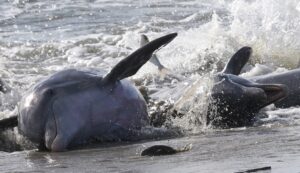
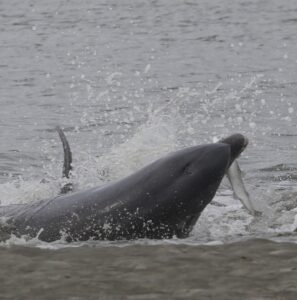
Strand Feeding is when dolphins herd fish up onto the beach by making a wave and then thrust at least half of their bodies up onto the sand, essentially stranding themselves, to catch and eat just one fish. They catch a fish and then quickly return to the water. Usually a group of dolphins, two to five, do this together. The result is a lot of splashing, fish flopping, some noise, a meal for the dolphins and some fascinating viewing. I saw this happen three times during my shift last week.

There are only a handful of places in the world where dolphins Strand Feed. Feeding this way is only one of the methods used to catch fish and is a learned behavior. Young dolphins are taught by their mother if she is one of those who feed this way. After birth, the calf will nurse for more than a year and then typically stays with their mother for three to six years. During that time the calf will learn to Strand Feed.

There are more than 300 dolphins in low country waters around Charleston. Of those, only a few Strand Feed. In the immediate area around Seabrook and Kiawah we have documented only two or three Strand Feeding females. If a mother is harassed or threatened by dogs or people, either in boats or on the beach, she is likely not going to strand feed and may not teach her calf to do so. Since female dolphins calve only once every three or four years, it would not take long for this learned behavior to disappear should mothers stop teaching their calves for any reason.

A group of Seabrook residents, myself included, volunteer to spend up to 4 hours (2 hours before and after low tide) on the beach at the Kiawah River inlet twice a month throughout the spring, summer and fall months. A similar group from Kiawah are on the opposite side of the inlet. We are there to educate people about the dolphins and to record data for scientific research. Lowcountry Marine Mammal Network (LMMN), lead by Lauren Rust, coordinates our activities and teaches us about the dolphins.

I became involved last year after watching a very disturbing Youtube video where someone tried to jump onto the dolphins while they were Strand Feeding. The incident occurred on the same stretch of beach where we now serve as volunteers. For me, if my presence deters such incidents from ever happening again, then it is well worth my time.

If you make the mile+ walk from board walk #1 to the Kiawah River inlet, also known as the ‘Spit’, and you are fortunate enough to see dolphins, please stand back at least 15 yards and do not try to get into the water with them. They may swim near you or even Strand Feed nearby, seemingly oblivious to your presence. But they know you are there and are just as likely to move on to another area or stop feeding altogether. It is not worth the risk of losing this behavior to future generations for a few pictures today. (Besides, with the cameras today and even our phones, the quality and zoom capability makes it very easy to get great pictures from 15 yards away.) Please give the dolphins some space so my grandchildren and yours will be able to see Strand Feeding many years from now.

While you are there a volunteer may approach to encourage you to view from a distance. Our purpose is only to teach people about this rare and wonderful gift we have on Seabrook and Kiawah Islands. If you would rather be left alone, just politely let us know and we will move on.

We hope you have a chance to see these wonderful animals and their unique behavior. It is all too easy to take these sightings for granted. Not long ago I was reminded how special our island is when friends from Canada were visiting and became so excited to see dolphins just a few yards away in the water. Unfortunately, we did not see any Strand Feeding that day. I can only imagine what their reaction would have been.

Here are a few facts about dolphins. Should you encounter a volunteer, I am sure they can share more with you. Just ask.

  • Dolphins only strand on their right side.
  • A dolphin can swim at speeds of over 30km/hour and dive as deep as 250m.
  • They weigh an average of 660 pounds and can reach a length of just over 13 feet.
  • A dolphin can hold its breath for 10-15 minutes.
  • Bottlenose dolphins, the type we have here at Seabrook, live typically between 30 and 50 years. Dolphins in captivity live much shorter lives than wild dolphins.
  • The dolphins in our area Strand Feed at almost anytime, however, the prime time is about an hour before and after low-tide.
  • It is a good bet that you will see them in the Kiawah River inlet between Seabrook Island and Seabrook Island.

If you witness dolphins being harassed you should contact either the beach patrol (843-718-6083) or security (843-768-6641). The US Government has passed the Marine Mammal Protection Act which makes it illegal to harass or interfere with the dolphins. Fines can be as much as $100,000. You can learn more about the act here: https://www.fisheries.noaa.gov/topic/laws-policies#marine-mammal-protection-act

Article by: Philip Miller
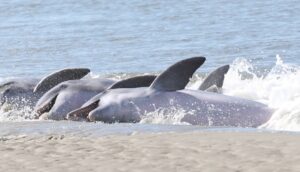
Credit for the images to Lowcountry Marine Mammal Network, Lauren Rust
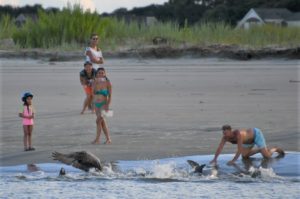


Incidents in the news

Just wanted to share two incidents we had last week if you haven’t already seen them (pictures are attached). Please always document if you can (video is best) and call beach patrol if no volunteer is onsite or you need backup. I’ve alerted Kiawah and Seabrook Town Council.
The first incident I witnessed was a kayaker who stopped on SBI to fish. When the dolphins arrived, the man teased and tossed bait fish at the dolphins, at one point on his hands and knees splashing the water with this fish before tossing it to the dolphin. Unfortunately, we did not have an educator onsite that day to talk to him so I called beach patrol. He stopped but the dolphin continued to approach the man, likely looking for food.
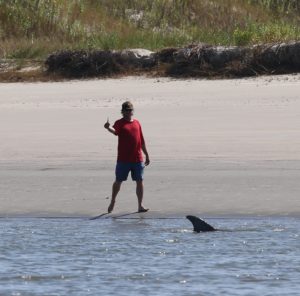
The second incident occurred on July 25th. My volunteer on Kiawah witnessed the man in the photo grabbing the fish as the dolphins pushed them ashore to feed and was teasing the dolphins with it before tossing it to them. Again, beach patrol was controlled and gave the man a warning. Feeding dolphins is a federal offense. Unfortunately, beach patrol only gave warnings and without their information, we cannot pursue any further legal action.
Here’s some recent news articles we’ve been featured in.

Lauren Rust

Executive Director
Lowcountry Marine Mammal Network

Dolphin Education Program

The Seabrook Island and Kiawah Dolphin Education Program begins.

We are really looking forward to getting back to the beach and a small part of normalcy. We’ve been given approval to start the Dolphin Education program back up with some modifications. Volunteers will begin 1 – 2 shifts per month during May.  They will be on the beach for approximately 4 hours (2 hours before low tide until 2 hours after low tide) throughout the summer.

For now, we are posting the signs and collecting the data. We’ll record number of people on the beach but we are not proactively approaching the public, UNLESS there is in incident/interaction, while still following social distancing guidelines.

See you on the beach!

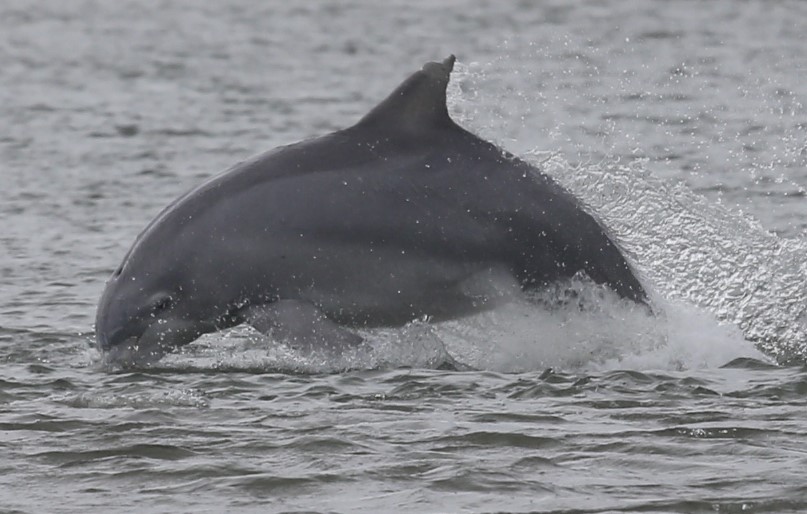
I spotted STEP being very playful yesterday. STEP is at least 28 years old, has had 5 recorded calves and has been monitored in Charleston since 1996. She’s a frequent visitor of the spit and I often think of her as the ‘matriarch’ of the group. Anyway, based on these photos I took yesterday, there’s a lot of buzz that she might be pregnant (or just a great eater)! I don’t want to get your hopes up but fingers crossed. See her dorsal fin, she’s pretty recognizable so keep your eyes out over the next few months and let me know if you spot her with a very small calf. Lauren

Step may be pregnant!
She’s either pregnant or a good eater!

Dolphin Education 2020 Kickoff

The Dolphin Education 2020 program for Kiawah and Seabrook will be having a kickoff/refresher meeting (similar to last year) on May 5th from 10-12pm followed by a beachwalk (only for new volunteers). The meeting is required for all new and current volunteers. Please bring any interested friends, neighbors, etc. It will be located again at the Oyster Catcher Community Center (Seabrook). 

Humpback Whales

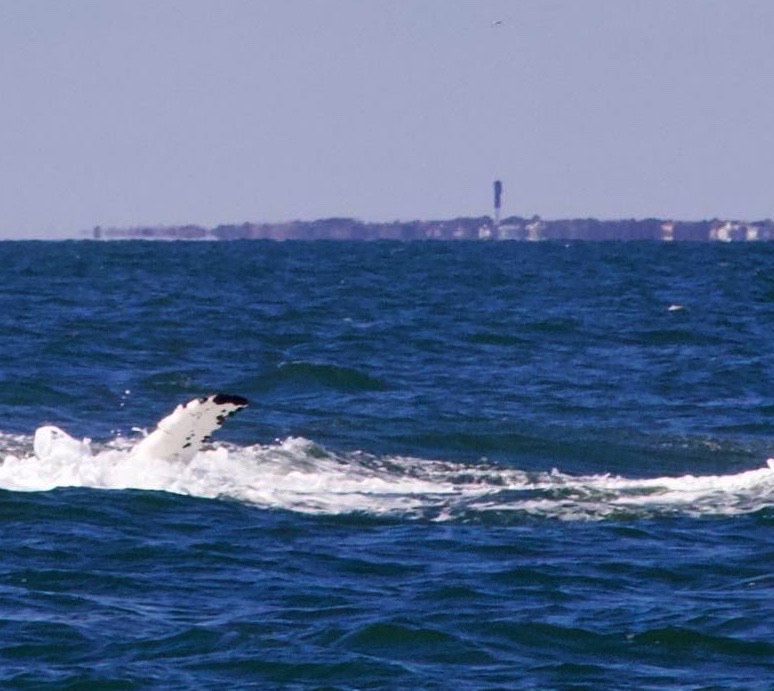
Humpback whale feeding off IOP (Isle of Palms) yesterday! They are not uncommon to be off our coast during their seasonal migrations but don’t typically come so close. Pretty cool!

Dolphin Nursing

Submitted by Lauren Rust, Lowcountry Marine Mammal Network

I got this neat image of KoKo feeding on Friday. If you look closely you can see two mammary slits on either side of her vaginal slit. This is one way to sex an animal from a photograph (it’s just hard to get such a clear shot). (Males typically don’t have mammary slits- although sometimes we’ve ssen “false” mammary slits in males). In each mammary slit is an inverted nipple. When Kai needs to nurse, he’ll nudge the mammary slit with his nose, which causes the nipple to pop out and allows him to grip and nurse. If you look closely, you’ll see what looks like “bulges” slightly closer to her belly and this is her mammaries full of milk since she’s still lactating. How cool is that?

5 Whales Stranded on Edisto

Submitted by Lauren Rust, Lowcountry Marine Mammal Network

If you haven’t heard about the pilot whales yet, we had a mass stranding (5 whales) that stranded alive on Edisto Saturday morning. This comes on the heels of 50 pilot whales that stranded in GA in July, followed by an additional 20+ last week in Brunswick. 15 died in Brunswick and another 8 were seen swimming in a small inlet but never stranded. Through matching their dorsal fins, we were able to confirm that the 5 whales from Edisto were part of the 8 they had been seen in GA last week. I was a first responder on Saturday and was the only one onsite for about 2 hours before relief came. It was heartbreaking because there was nothing we could do for the whales by that time and three had to be euthanized (one died on its own). In some cases like this, whales can be re-floated back to sea, if people find them quick enough. These animals had been on the beach for several hours (if not overnight) before anyone found them. Laying on the beach that long can cause irreversible organ damage due to gravity. Dehaydration had probably set in by that time as well. For those reasons, a local vet from Charleston assessed them and euthanized them. A 5th whale was seen just offshore all morning, later seen circling in a tidal pool, stranded around 4pm and pushed back by people, never to be seen again. We have a debrief this Friday to discuss what’s going on. So far, the necropsies from about 7 of them have shown nothing grossly, and additional tests are pending to rule out biotoxins, diseases, trauma. Two of the animals  from Edisto were CT scanned at ther aquarium yesterday (heads only) to look for possible trauma (for ex. they can have shattred ear bones if exposed to loud sonic booms), which would cause disorientation and a possible explanation of stranding. Some viral infections can also cause disorientation. These animals typically live 100 miles offshore in very deep water (1000 meters or more) so we’re trying to determine what’s bringing them so close to shore. Pending tests could take several week or more for results. It’s not uncommon for pilot whales to mass strand. They are socail animals and swim in large pods (50-100 individuals), and sometimes if one individual (a leader maybe) is sick, the whole pod will follow that animal, even if it means close to shore. Once close to shore, the shallow water, currents and tides can confuse them since they are used to be in very deep water. This could cause them to get stuck, strand, etc. This is why we sometimes re-float the animals because often many of them are healthy but got disoriented. 

Charleston Magazine

Charleston Magazine wrote a 13 page feature on the local dolphin population. They did an outstanding job getting our messaging across and LMMN is part of the feature. Check it out!