Seabrooker Article re Dolphins May 15 2019

I had my first shift of the year last week. Going to our beach is always a pleasure, but when I have the opportunity to see wild dolphins and their unique ’Strand Feeding’ behavior, I also feel so very fortunate.

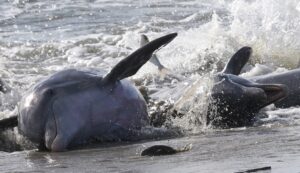
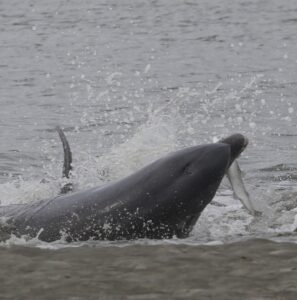
Strand Feeding is when dolphins herd fish up onto the beach by making a wave and then thrust at least half of their bodies up onto the sand, essentially stranding themselves, to catch and eat just one fish. They catch a fish and then quickly return to the water. Usually a group of dolphins, two to five, do this together. The result is a lot of splashing, fish flopping, some noise, a meal for the dolphins and some fascinating viewing. I saw this happen three times during my shift last week.

There are only a handful of places in the world where dolphins Strand Feed. Feeding this way is only one of the methods used to catch fish and is a learned behavior. Young dolphins are taught by their mother if she is one of those who feed this way. After birth, the calf will nurse for more than a year and then typically stays with their mother for three to six years. During that time the calf will learn to Strand Feed.

There are more than 300 dolphins in low country waters around Charleston. Of those, only a few Strand Feed. In the immediate area around Seabrook and Kiawah we have documented only two or three Strand Feeding females. If a mother is harassed or threatened by dogs or people, either in boats or on the beach, she is likely not going to strand feed and may not teach her calf to do so. Since female dolphins calve only once every three or four years, it would not take long for this learned behavior to disappear should mothers stop teaching their calves for any reason.

A group of Seabrook residents, myself included, volunteer to spend up to 4 hours (2 hours before and after low tide) on the beach at the Kiawah River inlet twice a month throughout the spring, summer and fall months. A similar group from Kiawah are on the opposite side of the inlet. We are there to educate people about the dolphins and to record data for scientific research. Lowcountry Marine Mammal Network (LMMN), lead by Lauren Rust, coordinates our activities and teaches us about the dolphins.

I became involved last year after watching a very disturbing Youtube video where someone tried to jump onto the dolphins while they were Strand Feeding. The incident occurred on the same stretch of beach where we now serve as volunteers. For me, if my presence deters such incidents from ever happening again, then it is well worth my time.

If you make the mile+ walk from board walk #1 to the Kiawah River inlet, also known as the ‘Spit’, and you are fortunate enough to see dolphins, please stand back at least 15 yards and do not try to get into the water with them. They may swim near you or even Strand Feed nearby, seemingly oblivious to your presence. But they know you are there and are just as likely to move on to another area or stop feeding altogether. It is not worth the risk of losing this behavior to future generations for a few pictures today. (Besides, with the cameras today and even our phones, the quality and zoom capability makes it very easy to get great pictures from 15 yards away.) Please give the dolphins some space so my grandchildren and yours will be able to see Strand Feeding many years from now.

While you are there a volunteer may approach to encourage you to view from a distance. Our purpose is only to teach people about this rare and wonderful gift we have on Seabrook and Kiawah Islands. If you would rather be left alone, just politely let us know and we will move on.

We hope you have a chance to see these wonderful animals and their unique behavior. It is all too easy to take these sightings for granted. Not long ago I was reminded how special our island is when friends from Canada were visiting and became so excited to see dolphins just a few yards away in the water. Unfortunately, we did not see any Strand Feeding that day. I can only imagine what their reaction would have been.

Here are a few facts about dolphins. Should you encounter a volunteer, I am sure they can share more with you. Just ask.

  • Dolphins only strand on their right side.
  • A dolphin can swim at speeds of over 30km/hour and dive as deep as 250m.
  • They weigh an average of 660 pounds and can reach a length of just over 13 feet.
  • A dolphin can hold its breath for 10-15 minutes.
  • Bottlenose dolphins, the type we have here at Seabrook, live typically between 30 and 50 years. Dolphins in captivity live much shorter lives than wild dolphins.
  • The dolphins in our area Strand Feed at almost anytime, however, the prime time is about an hour before and after low-tide.
  • It is a good bet that you will see them in the Kiawah River inlet between Seabrook Island and Seabrook Island.

If you witness dolphins being harassed you should contact either the beach patrol (843-718-6083) or security (843-768-6641). The US Government has passed the Marine Mammal Protection Act which makes it illegal to harass or interfere with the dolphins. Fines can be as much as $100,000. You can learn more about the act here: https://www.fisheries.noaa.gov/topic/laws-policies#marine-mammal-protection-act

Article by: Philip Miller
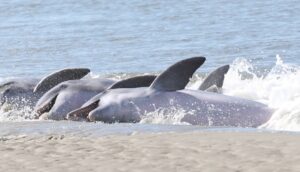
Credit for the images to Lowcountry Marine Mammal Network, Lauren Rust
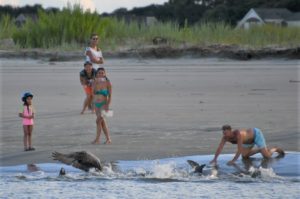


Incidents in the news

Just wanted to share two incidents we had last week if you haven’t already seen them (pictures are attached). Please always document if you can (video is best) and call beach patrol if no volunteer is onsite or you need backup. I’ve alerted Kiawah and Seabrook Town Council.
The first incident I witnessed was a kayaker who stopped on SBI to fish. When the dolphins arrived, the man teased and tossed bait fish at the dolphins, at one point on his hands and knees splashing the water with this fish before tossing it to the dolphin. Unfortunately, we did not have an educator onsite that day to talk to him so I called beach patrol. He stopped but the dolphin continued to approach the man, likely looking for food.
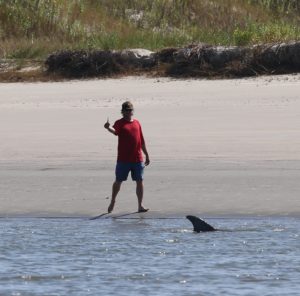
The second incident occurred on July 25th. My volunteer on Kiawah witnessed the man in the photo grabbing the fish as the dolphins pushed them ashore to feed and was teasing the dolphins with it before tossing it to them. Again, beach patrol was controlled and gave the man a warning. Feeding dolphins is a federal offense. Unfortunately, beach patrol only gave warnings and without their information, we cannot pursue any further legal action.
Here’s some recent news articles we’ve been featured in.

Lauren Rust

Executive Director
Lowcountry Marine Mammal Network

Dolphin Education Program

The Seabrook Island and Kiawah Dolphin Education Program begins.

We are really looking forward to getting back to the beach and a small part of normalcy. We’ve been given approval to start the Dolphin Education program back up with some modifications. Volunteers will begin 1 – 2 shifts per month during May.  They will be on the beach for approximately 4 hours (2 hours before low tide until 2 hours after low tide) throughout the summer.

For now, we are posting the signs and collecting the data. We’ll record number of people on the beach but we are not proactively approaching the public, UNLESS there is in incident/interaction, while still following social distancing guidelines.

See you on the beach!

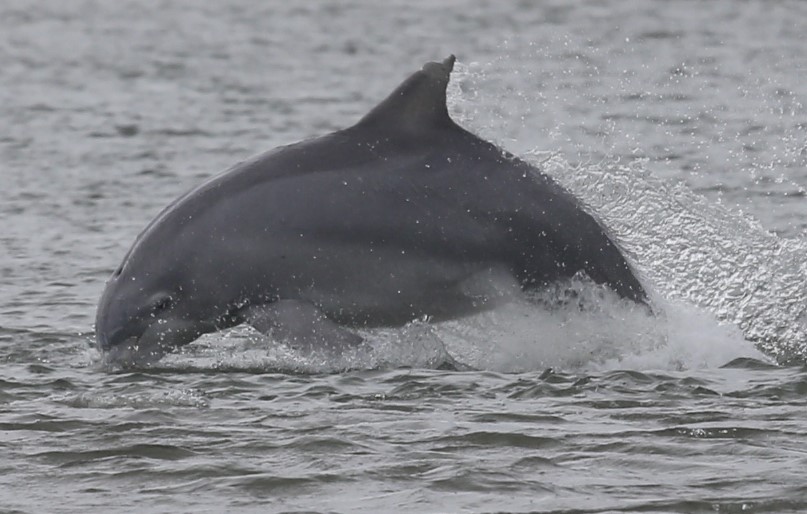
I spotted STEP being very playful yesterday. STEP is at least 28 years old, has had 5 recorded calves and has been monitored in Charleston since 1996. She’s a frequent visitor of the spit and I often think of her as the ‘matriarch’ of the group. Anyway, based on these photos I took yesterday, there’s a lot of buzz that she might be pregnant (or just a great eater)! I don’t want to get your hopes up but fingers crossed. See her dorsal fin, she’s pretty recognizable so keep your eyes out over the next few months and let me know if you spot her with a very small calf. Lauren

Step may be pregnant!
She’s either pregnant or a good eater!

Charleston Magazine

Charleston Magazine wrote a 13 page feature on the local dolphin population. They did an outstanding job getting our messaging across and LMMN is part of the feature. Check it out!

Dolphin Watch Guidelines

I just wanted to go over the ordinances again as the summer begins.

  • Kayakers are allowed to beach kayaks on the beach and stay, get out, etc.
  • Boats are allowed to drop/pick up people on the inlet. The Kiawah resort boat often does this in the summer dropping off kayakers or groups as part of an ecology class they offer. This requires them coming close to shore and the ppl need to wade in water to get to/from boat. Boats are NOT ALLOWED to anchor on shore. I will be meeting with the Kiawah resort/Mingo group on Thursday to go over all of this and the dolphins guidelines so after Thursday all the boat drivers/naturalists/staff should be trained.
  • People are not allowed to swim or wade in the water. 
  • Dogs are not allowed at the spit- starting at the “No Dogs Allowed” sign on Kiawah and buoy on Seabrook. 
  • The Kiawah dolphin tour boat (or any boat) should slowly go up and down the inlet not making any sudden turns to see dolphins. They can stop but we don’t want boats or kayaks turning quickly or chasing dolphins. Unfortunately, there’s not much we can do with ppl in the water. Kayakers that rent from Mingo Pt. are told the regulations but up to them to adhere to them.
  • Please try to talk to people before calling beach patrol. We want to be a positive program on the islands and want to make sure we all know the ordinances.
  • During your beach shift- please try and be proactive vs. reactive, meaning approach and talk to people instead of waiting until something happens and you’re rushing over. I don’t expect you to talk to every inlet visitor as it gets busy but it’s better to talk to people even if dolphins are not there or at the other side of the inlet. You never know when dolphins might pop up and then you’re trying to rush over to intercept an interaction. We are there to stop and intercept interactions but also to provide education. Many people are coming to the spit to see dolphins- if there are no dolphins and you didn’t talk to them, they may come back tomorrow(or rent kayaks)  and say there was no educator on that day or an educator couldn’t get to them—they will not have that information and might unintentionally harass dolphins. Had you educated them the day before, they will hopefully act responsibly the next time. 
  • During the summer- it will be busy and hard to talk to everyone only when dolphins are present- also hard to reach everyone up/down the spit. P{lease make an effort to talk to folks when dolphins are not present so you’re not running around when dolphins are present.
  • A good segway: “Hello, did you know this is a dolphin feeding ground?…We’re out here to help protect feeding dolphins…I haven’t seen dolphins today but they often come here to feed…if they come close to shore, can you stay back 15 yards?” 
  • I also approach kayakers and say…”Hello, did you know there are kayak regulations if you see dolphins?…Dolphins are protected and the regulations are not to approach dolphins within 50 yards from your vessel. They can approach you but never chase, follow or pursue. It’s best to lift your paddles and enjoy. It’s also illegal to touch, feed, swim with or encourage them to your boats by clapping or splashing the water…
  • People should stay back 15 YARDS (not feet). This is 45 feet.
  • Let me know any questions!Lauren

Here are the KIAWAH ordinances:

  • 15-314. – Wading/swimming prohibited at Captain Sam’s Inlet.

It shall be unlawful for any person to wade or swim in the waters in and around Captain Sam’s Inlet.

(Code 1993, § 15-315)

Sec. 16-803. – Launching or retrieving of vessels restricted. 

(a) No person shall launch or retrieve a vessel, excluding sailboats, surfboards, rafts, inner tubes or similar devices, anywhere on the beach seaward of the mean high water mark, except in case of emergency.

(b) No person shall propel or cause to move any vessel, except sailboats, surfboards, rafts, inner tubes or similar devices from the water onto the sand beach above the mean low-water mark anywhere on the beach seaward of the mean high-water mark, except in case of emergency.

(Code 1993, § 16-803; Ord. No. 2001-2, 3-13-2001)

This one is for SEABROOK:

  • 32-48. – Launching or retrieving vessel. 

(a) No person shall launch or retrieve a vessel, excluding sailboats, surfboards, rafts, inner tubes, kayaks or similar devices, anywhere on the beach seaward of the mean high-water mark, except in the case of emergency.

(b) No person shall propel or cause to move any vessel, except sailboats, surfboards, rafts, inner tubes, kayaks or similar devices from the water onto the sand or anywhere on the beach above the mean low-water mark, except in the case of an emergency.

(Ord. No. 2015-02, § I, 7-28-2015)


Charleston Harbor Bottlenose Dolphin Facts

How many Charleston individuals? 

Based on our mark-recapture estimates from 2004-06, between 300-400 for CES stock (Charleston Estuarine Stock).

What is their range? 

Depends on sex and area affiliation.  Most females tend to have smaller ranges encompassing a couple rivers and the smaller associated creeks.  Some males can be seen throughout most of stock, from Charleston Harbor to North Edisto.  

Which river(s) are most popular, why?

Stono appears to be the most popular, followed by the Folly and North Edisto. The Ashley, Cooper, and Wando Rivers are popular depending on the time of year. The popular areas are probably due to amount or prey, fewer boats, and proximity to coast.

Male/female ratio? 

According to biopsies, the estimate is around 186 males to 107 females (biased since biopsies always favor males).  According to sightings and research, the estimate is 217 males to 411 females (biased since females are easier to detect (presence of calf) vs males).

Approximately how many births per year? 

Good consistent records from 2005-2009 indicate an average of 35 births/year.

Oldest individuals? 

Animal FB864 was recently spotted in the harbor and is recorded as 36 yrs old. His age was confirmed because he was captured and tagged in the early 2000’s. A tooth was pulled to age him. Oldest known CES dolphins (assuming he is still alive, last seen in 2009) is FB894 who would be 42.  Oldest female (assuming she is still alive, last seen in 2009) is FB805 who would be 41.

Alliances? Male/male? Females/females and calves? 

Yes, male pairs are prevalent.  We’ve noted dozens of them here.  Possibly had a three male “alliance” but not seen together with same frequency as pairs.  Likely a pair and a wanna-be male.  Females tend to stick together especially with calves. Females are known to “babysit” other female calves.

How do they use the harbor-spatially and behaviorally? 

Can be seen throughout the harbor with hot spot behind Fort Sumter.

Main source of food in Charleston Harbor? 

Based on Pate and McFee from 2012, Star Drum was the most abundant prey species for SC dolphins, with Brief Squid the most frequently observed prey item (all from stranded dolphins throughout the state).

What threats do the bottlenose dolphins in the Charleston Harbor face?

There are documented reports of fishery-related mortality and serious injury to the population related to the blue crab pot fishery. During a review of bottlenose dolphin strandings in South Carolina from 1992 to 2003, it was found that 24% of the 42 entanglements of dolphins were associated with crab pots and 19% of entanglements deemed probable to be from interactions with crab pots. Between 2003 and 2007, 12 bottlenose dolphins displayed evidence of being entangled in crab pots. In addition, standings in South Carolina have been greater near urban areas and agricultural input, suggesting negative health effects to bottlenose dolphins in these areas. Reduced immune response has been reported due to an increase in concentrations of several containments, such as mercury, copper, manganese, lead, uranium, and zinc.
Some of the highest concentrations of polychlorinated biphenyls (PCBs) and DDT reported for cetaceans have been founded in the blubber of bottlenose dolphins from the Charleston area.
https://www.nefsc.noaa.gov/publications/tm/tm219/441_BODO_CES.pdf

Do they interact with crab pots a lot? 

Based on strandings and entanglements, they appear to. Dolphins have been seen tugging on crab pot lines.

What makes them unique? 

Strand feeding is probably the most unique feature of CES dolphins, which is seen mostly in SRE (Stono River Estuary). Strand feeding is a unique feeding behavior where dolphins corral fish near sandy shores then create a large wave to push the fish and themselves onto shore to eat the fish before returning to the water. Strand feeding has only been documented in South Carolina and Georgia in the USA. It occurs in several rivers around Charleston. Not all dolphins strand feed and those that do use strand feeding as a secondary feeding behavior. It’s a learned behavior from mom. Dolphins only strand on their right side and typically in small groups (1-3 animals).

General Bottlenose Dolphin Facts

Here are some general questions and their answers to help the outreach learn more about Bottlenose Dolphins.

How long is their gestation period?

12 months. The calf will nurse for more than a year and then typically stays with their mother for three to six years.

How fast can they swim?

They can reach speeds of over 30km/hour and dive as deep as 250m.

How much do they weigh? How long are they?

An average of 660 pounds. They can reach a length of just over 13 feet.

What are their different fins used for?

The fluke (tail fin) is used to propel through the water and the pectoral fins (on each side) provide the direction control and the dorsal fin (on top) provides stability.

Do dolphins travel in groups?

Yes. They travel in groups, called ‘pods’. Although, adult males mostly travel alone or with smaller groups and then join the pod for a short time.

What is echolocation?

Bottlenose dolphins produce high-pitched clicks to navigate and find food. When the clicking sound hits an object, it bounces back to the dolphin as echoes, which allows the dolphins to determine the location, size, shape of the object.

What do bottlenose dolphins eat?

They are carnivores so they feed on mostly fish, but can also eat shrimp, crab, or squid. Locally, they eat Star Drum, Menhaden and Mullet.

How long can a dolphin hold its breath for?

10-15 minutes. Dolphins breathe through their blowhole; a muscular flap covers their blowhole while they are underwater.

How do dolphins sleep?

They float just beneath the surface of the water and small movements of their tail flukes propel them to the surface so they can take breaths while sleeping.

Do dolphins mate for life?

Dolphins do not mate for life. Dolphins mate for reasons other than reproductions, similar to humans and when food is scarce, they may not mate at all to focus on survival.

How long do bottlenose dolphins live?

Typically between 30 and 50 years. Dolphins in captivity live much shorter lives than wild dolphins.

What protections are in place to protect them?

Dolphins face various threats around the world, including direct kills, entanglements in fishing gear, live captures for captivity, habitat alteration, boat collisions, and the negative effects of pollution. Fortunately, bottlenose dolphins are protected in U.S. waters under the Marine Mammal Protection Act, which makes it illegal to “take” marine mammals without a permit. A “take” includes harassment, feeding, hunting, capturing, collection, or killing any marine mammal.